The study of ancient Egypt is, often implicitly, situated in a framework derived from elite source material that marginalizes commoners as ‘have-nots’, disempowered, and unimaginative. SUBALTERNEGY shifts the paradigm and examines the same society, but from below. It asks how people that had slipped – or been pushed – to the bottom of a developing social hierarchy accommodated their lived experience, what means they had to secure agency in their lives, and how they imagined the world as a meaningful place. The approach is not a critique of the prevailing elite bias in Egyptological research, which many socially aware Egyptologists acknowledge but which is hardly ever developed into an alternative approach. Rather, it is a realisation that the seemingly unsophisticated nature of non-elite source material, when compared to the glamourous world of monuments and hieroglyphs, has prevented researchers from finding the creativity and complexity of ‘ordinary’ life.
This project seeks nothing less than to invert social analysis by proposing a new approach to the study of ancient Egypt, one that will countenance the cross-fertilization of ideas surrounding other early complex societies discussed in archaeology, history, and social anthropology. It exploits the potential of material culture as a pervasive context for the communication of everyday ideas and practices. The hypothesis driving the project is that people of all social groups strive for a meaningful life and, to this end, position themselves and are positioned in social relationships expressed in material culture and the built environment, which reflect, reproduce, and at times contest the social order.
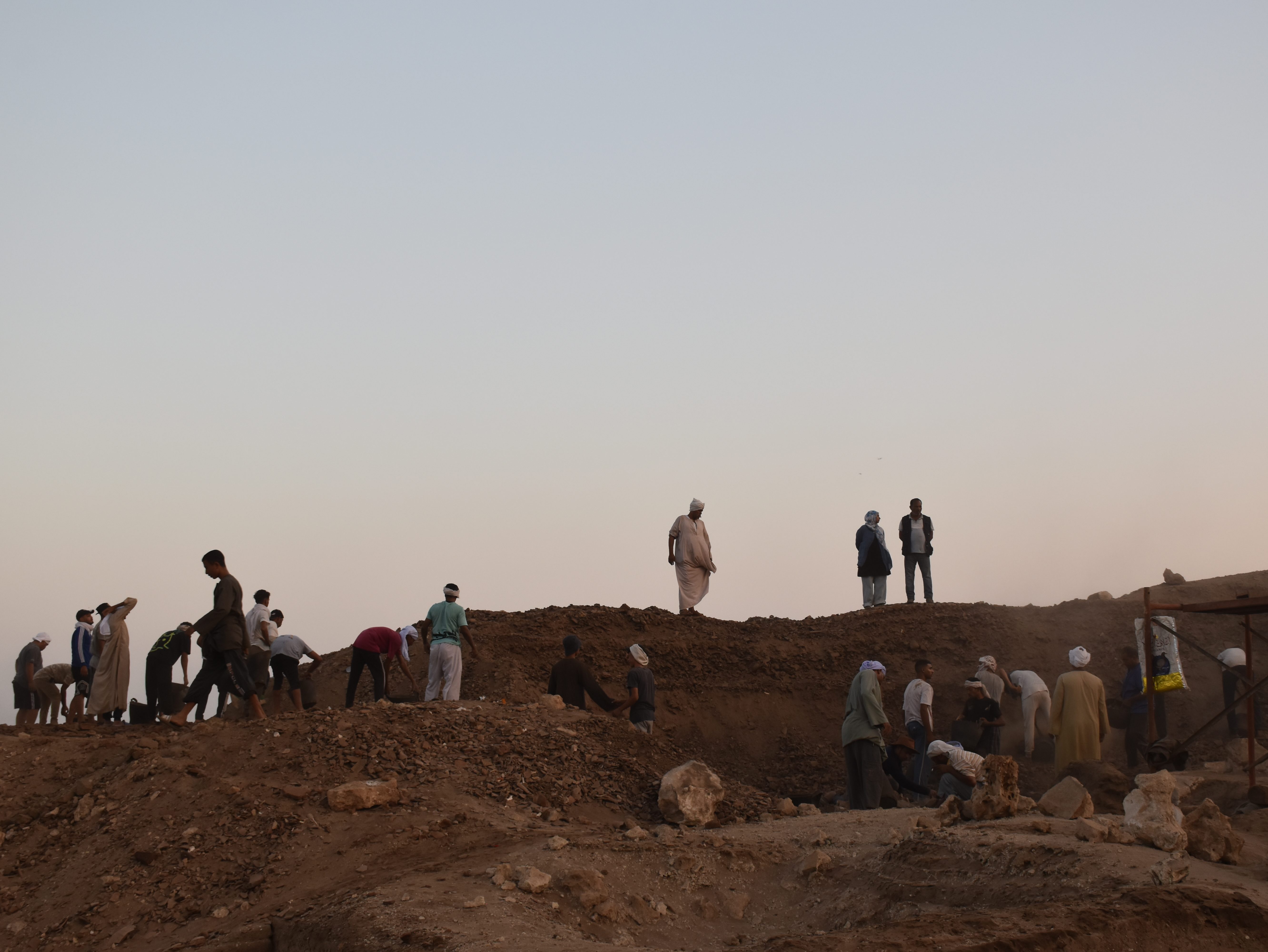
SUBALTERNEGY draws on fresh data from my on-going excavations at Zawyet Sultan that have so far revealed a small proportion of a vast low-status cemetery (Bussmann, Vanthuyne 2024). The exceptional preservation of the graves, skeletal remains, and associated artifacts offers a unique opportunity to study the burial practices of low-status groups within the context of a stratified local community, using state-of-the-art technologies. An interdisciplinary methodology derived from archaeology, anthropology, geophysics, visual studies, and cultural history will be developed within SUBALTERNEGY that for the first time in Egyptology combines postcolonial, relational, and practice theories (van Dommelen 2006; Dietler 2010; Harris 2021; Kienlin, Bussmann 2022).
Engagement with postcolonial theory, from which subaltern studies emerged, will help to identify the mechanisms that marginalize communities, and will frame the ensuing discussion into one in which hegemonic and subaltern voices are inherently entangled in the source material, rather than treating them as circumscribed bodies of ideas and practices belonging to discrete social groups.
The project adopts the key premise of relational theory that an entity only exists insofar as it is related to another entity, thus, studying how social and material relationships were enacted emerges as a far more nuanced approach than the traditional top-down search for social structure. Practice theory foregrounds the agency of people – some researchers would add the agency of other beings and of the material world – vis-à-vis a prevailing social order.
SUBALTERNEGY embraces this position as a means by which to assess and discuss diachronic change and the diversity of human behaviour observable in the material evidence, thus challenging the assumption that practices emerge predictably from an existing social structure or an ideational world.
This approach will engage qualitatively and contextually with an ancient Egyptian community and reveal the situational and material contexts that articulated its social relationships. The essence of the project lies in revealing the agency, imaginative capacities, and relationships of interacting social groups as a critical mechanism for the re-evaluation of hegemonic concepts in ancient Egyptian society. The discussion arising will also address questions of cohesion, correlation, and disjunction within and between different types of data for purposes of social modelling (Bussmann 2022).
Despite the substantial record available for studies of everyday life in ancient Egypt, most discussions remain at a descriptive level or are restricted to individual case studies. The evidence is hardly ever used to expose alternative or even conflicting worldviews to those interpreted from elite culture, views that might unhinge the naturalizing effect of dominant ideologies. The project will offer a synthesis that combines the results of excavations at Zawyet Sultan with dispersed and underutilized data from other contexts. SUBALTERNEGY thus fosters the developing links between theoretical self-reflection in Egyptology and cross-disciplinary intellectual debates (Baines 2011).
The objectives of the project are to:
- Produce a substantial record of contextualized data for a low-status ancient Egyptian community cemetery;
- Understand how burial practices transformed diverse lived experiences into local imagined communities;
- Uncover how human bodies, the landscape, material culture, and visual discourse were used to enact social relationships;
- Develop concepts of subalternity and relatedness into a novel bottom-up approach to ancient Egyptian material.
SUBALTERNEGY has five main areas of research: burial practices, bodies, landscapes, visual discourse and synthesis.
Burial Practices
Assessments of ancient Egyptian burial practices have traditionally been descriptive or have focused on the tombs of mid- to high-ranking individuals (Assmann 2001; Baines, Lacovara 2002; Grajetzki 2003; Ikram 2007). We will depart from this convention by documenting and analysing burial practices in the low-status community cemetery at Zawyet Sultan, prioritizing integrated funerary culture (ritual activities, the actors involved, objects and other material remains, the institutional context), and emphasising diachronic change and local variability in low-status traditions. The working hypothesis 1 is that all members of the community at Zawyet Sultan shared similar ideas and practices with regard to the ideal treatment of the body, even if the symbolic and material vesting of burials differed according to social status. The evidence of Zawyet Sultan will be embedded in its regional context and compared to material from other relevant provincial community and courtly cemeteries to evaluate the similarities and differences of burial practice across various social groups.
Bodies
The treatment of the deceased in ancient Egypt has been understood as a mechanism for social discourse and human experience (Meskell 1999; Nyord 2009), though the bulk of research has focused on visual and textual evidence rather than on physical bodies, and rarely those of non-elite individuals. SUBALTERNEGY will use the skeletal remains excavated at Zawyet Sultan as a vector from which to reconstruct the physical realities of individual lives. Advancements in forensic pathology allow biological sex, the age at death, maladies, diet, and other physical characteristics of an individual to be determined with accuracy. Validated Entheses-based Reconstruction of Activity (VERA) analysis will be undertaken on multiple samples to reconstruct routine activities of the deceased during life. Ancient Egyptian visual and textual sources and the formal arrangement of burials suggest that ritual treatment was intended to transform the body into an image of the deceased, so we will use the burials at Zawyet Sultan to establish criteria from which to compare ideals of the body in low-status and elite imagery (Seidlmayer 2001; Bussmann in press).
Landscapes
Landscape is understood as socialized space, intrinsic to social relationships among and between the living and the dead, and therefore essential to the SUBALTERNEGY project. Geophysical survey and possibly auger probes will be employed to generate data for a reconstruction of the paleo-environment around Zawyet Sultan. The positions of tombs relative to one another, to the settlement of the living, to landscape features, and according to cardinal directions will be recorded and chronological developments charted to explore the social and material relationships of interment. The vertical landscape of Zawyet Sultan appears to afford an arrangement of tombs whereby the rank of the deceased determined the placement of a burial, though past work at the site has shown that the more complex arrangements of lived experience contradict simple intuitive interpretations. The situation in Zawyet Sultan will be charted with precision, analysed, and compared to the socio-spatial organisation seen in other cemeteries.
The project will extend the concept of “imagined communities” (Anderson 1983) into an analysis of funerary landscapes where the community includes both the living and the dead, to reveal the imaginative engagement of commoners with their social, cultural, and physical environments. We will test the hypothesis that there was a change in local funerary practice, from foregrounding social status to accommodating social relationships and eventually to highlighting religious ideas, over the course of the Old Kingdom.
Visual Discourse
Elite sculpture and paintings in the tombs of high-ranking officials abound with scenes that depict the tomb owner, his dependents, and commoners. Such scenes present the social world in a typological, or idealized, fashion, in which human bodies and social relationships are key themes in the visual discourse. W will apply discourse analysis to relevant examples of sculpture and paintings, including selected scenes in the rock tombs of Zawyet Sultan and our excavated material, to determine how social relationships were modelled across artistic genres and in the social contexts they express. Correlations and discrepancies among different types of evidence will be discussed with regard to the logics of genres and the social contexts of the evidence.
Synthesis
The culmination of the SUBALTERNEGY project will embed the results of the project in discussions of cross-cutting themes pertinent to the study of early complex societies. First, subalternity will be developed as an interpretive context in which to model the entanglement of hegemonic and marginalized voices in the archaeological record, and to explain overlaps and incongruities in datasets due in part to multivocal source material. The discussion will straddle fundamental themes in cultural theory and is designed to stimulate follow-up research. Second, the project will show – with empirical evidence – that burial customs reflected and produced “imagined communities” in the provincial hinterlands of early Egypt, revealing the imaginative capacities of subaltern communities rather than the voiceless low-status groups normally conceived in Egyptological research as passively responding to the physical needs of everyday life. The analysis will include assessments of the roles that social rank, gender, and age played in the formation of imagined communities. Third, it will reveal exchange mechanisms between social groups – the mobility of objects, practices, and ideas up and down the social ladder – and the societal transformations engendered by such mobility in a specific historical context. For example, burial customs may have varied across society, but ideas and practices borrowed across social groups might have been considered sufficiently similar to establish a shared sense of social cohesion. Fourth, the project will unfold a microhistory of the early Egyptian state and tread the middle ground between describing and overtheorizing archaic states. It will be argued that studying the contours of social relationships is more relevant for an understanding of what is commonly termed the ancient Egyptian state than focusing on institutions and theories of power. Fifth, global histories usually presuppose that the development of early complex societies marked the origin of social inequality. Social inequality in the modern world is seen as a prime driver of structural poverty and the destruction of the environment, but ancient Egyptian written discourse reveals a literate milieu in which the violation of social relationships was seen as a greater transgression than social inequality. The project will thus offer an alternative reading of early forms of inequality that foregrounds social relatedness. Sixth, the project will strengthen current attempts to decolonize Egyptology, by developing multi-voice work practices and highlighting decolonial and postcolonial theories that visualize Egypt, past and present, from below. The themes of SUBALTERNEGY forward a novel bottom-up approach to ancient Egyptian society that draws on theories of practice, and on postcolonial and relational theory.

 Zawyet Sultan